How Affiliate Sites With AI Are Changing the Passive Income Game
The Shift From Manual Work to Smart Automation
For years, building an affiliate site meant spending hours writing product reviews, researching keywords, and manually placing affiliate links. It was a grind. You needed either deep pockets to hire writers or enough free time to do everything yourself. Then the tools started evolving. ChatGPT gave us a way to generate content drafts in seconds. Jasper AI offered templates for product descriptions. And suddenly, the idea of running affiliate sites with AI stopped being a futuristic concept and became something you could test out on a Sunday afternoon.
I have been watching this space closely. What I see now is a real opportunity for people who want passive income but do not have a large audience or a background in SEO. The tools are getting better. The barrier to entry is lower. But there is a catch: you still need a strategy. Just publishing AI-generated text without any thought for quality or search intent will not work. Google SEO has gotten smarter, and it rewards sites that offer real value, not just word counts.
Why Affiliate Sites With AI Make Sense Right Now
Affiliate marketing has always been about matching people with products they need. The classic model was simple: write a review, include your Amazon Associates link, and hope people click. But scaling that model was hard. You needed to produce dozens of articles, each one unique and helpful. That is where AI changes the equation. Instead of writing every post from scratch, you can use tools like Copysmith or Jasper AI to create a first draft, then edit it with your own voice and experience. The time savings are enormous.
But here is the nuance. AI-generated content often lacks the personal touch that makes readers trust a recommendation. If you are promoting a tool like Builderall or a hosting service like Kinsta, your audience wants to know you have actually used it. So the smart approach is to let AI handle the heavy lifting of research and structure, then layer in your own stories and opinions. That hybrid method is what separates a site that grows from one that gets buried in the search results.
Picking the Right Affiliate Programs
Not all affiliate programs are created equal. Some have generous commissions but terrible conversion rates. Others pay less but have a loyal customer base that buys regularly. Here is a short list of programs that work well with an AI-assisted content strategy:

- Amazon Associates: Huge product selection, low barrier to entry, but commissions can be thin on low-ticket items.
- ShareASale: Great for digital products and services, with reliable tracking and a wide network of merchants.
- ClickBank: Ideal for high-ticket information products, though you need to vet the vendors carefully.
- AffiliateWP: Perfect if you are promoting WordPress plugins or themes, as it integrates directly with WooCommerce.
Each of these programs has its own quirks. For example, Amazon Associates requires you to generate sales within 24 hours of a click, which means your content needs to drive immediate action. ShareASale, on the other hand, gives you more flexibility with longer cookie durations. When you are building affiliate sites with AI, you want to pick programs that match the kind of content you can produce at scale. If your AI tool is good at writing product comparisons, go with programs that have a lot of comparable products. If it excels at tutorials, choose programs that offer recurring commissions.
Tools That Make the Work Easier
I have tested a lot of software over the years. Some of it is overhyped. But a few tools genuinely cut down the time it takes to build a profitable site. For keyword research, SEMrush and Ahrefs are still the gold standard. They help you find topics that have search volume but not too much competition. For content creation, ChatGPT and Jasper AI are the most versatile, though you need to proofread everything they produce. RankMath is a solid WordPress plugin that guides you through on-page SEO without needing to be a technical expert.
Design and visuals matter too. A site that looks amateurish will struggle to build trust. Canva is great for creating custom images and infographics, even if you have no design skills. Midjourney can generate unique illustrations that make your articles stand out, though you should always check the licensing terms. For hosting, Kinsta provides fast load times, which is a known ranking factor in Google SEO. And for email marketing, AWeber helps you capture leads and follow up with subscribers, turning one-time visitors into repeat readers.
The Role of Analytics and Refinement
Once your site is live, the real work begins. You need to track what is working and what is not. Google Analytics is the obvious starting point. It shows you which pages get traffic, how long people stay, and where they drop off. But do not stop there. Use SEMrush or Ahrefs to monitor your keyword rankings over time. If a page is ranking on page two, tweak the content. Add more detail. Improve the internal linking. Sometimes a small change, like rewriting a subheading or adding a comparison table, can push a page to the top of the results.
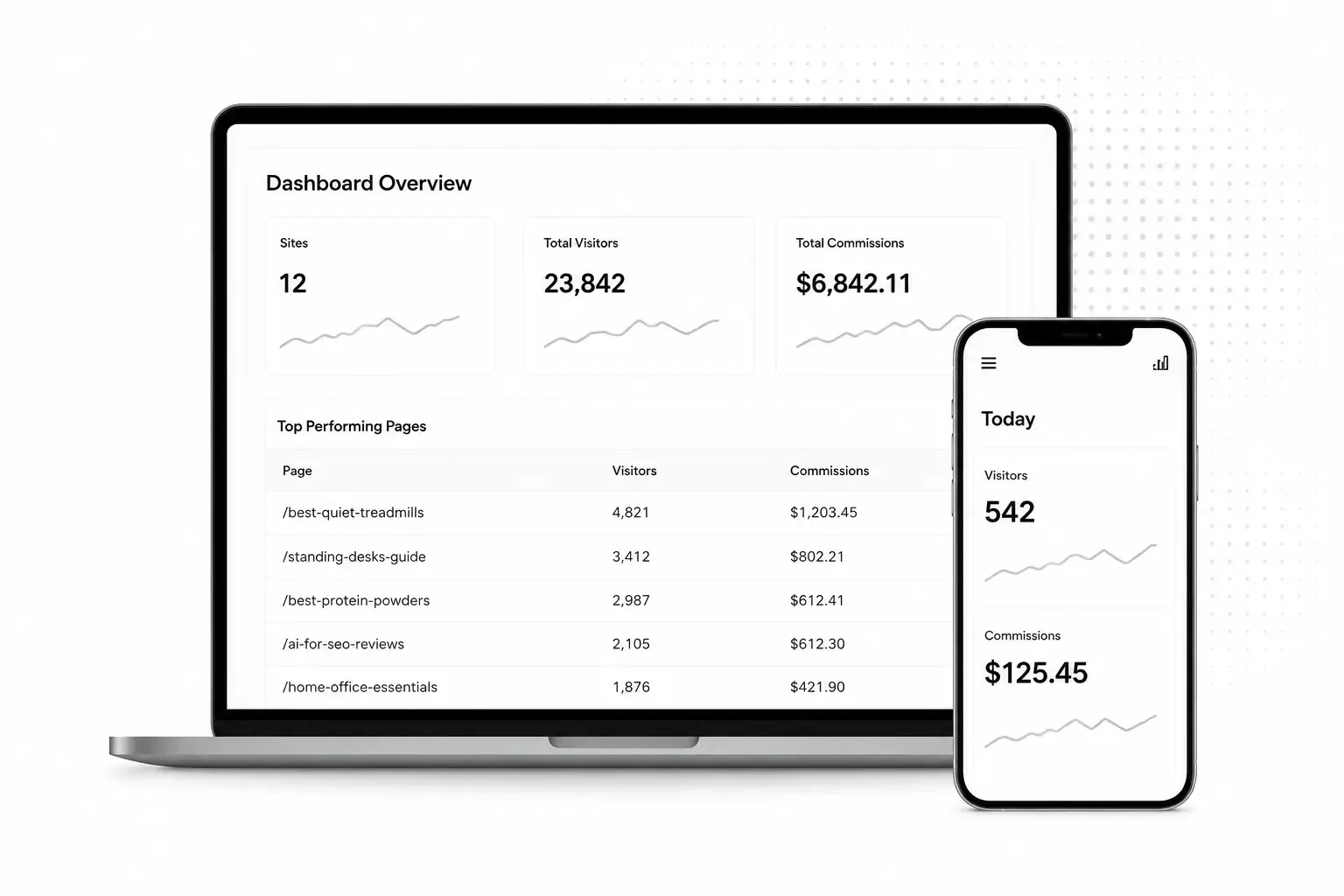
One thing I have learned the hard way: don't obsess over traffic alone. Affiliate income depends on conversions, not just clicks. A page that gets 500 visitors a day but has a low click-through rate on your affiliate links is less valuable than a page that gets 100 highly targeted visitors who are ready to buy. Focus on search intent. If someone is searching for "best email marketing tool for beginners," they probably want a comparison. If they search for "AWeber vs Mailchimp," they want a head-to-head breakdown. Match your content to what the searcher actually needs.
A Practical Workflow for Beginners
If you are just starting out, here is a simple workflow that I have seen work for multiple people:
- Use SEMrush or Ahrefs to find a keyword with decent volume and low competition. Aim for topics where you can add a personal angle.
- Open ChatGPT or Jasper AI and ask for an outline based on that keyword. Review the outline and adjust it to include your own experiences.
- Write the first draft yourself, or use the AI to generate a draft and then heavily edit it. Add your own stories, opinions, and specific examples.
- Optimize the post with RankMath. Set a focus keyword, write a meta description, and check the readability score.
- Publish on a platform like Squarespace, WordPress, or even Blogspot if you want to test the waters for free. But for a serious site, go with WordPress and use a lightweight theme.
- Promote the post through social media and email. If you have a list on AWeber, send a quick note to your subscribers.
- Monitor performance in Google Analytics. After a few weeks, revisit the post and add more examples or update any outdated information.
This loop of research, creation, and refinement is what turns an average site into one that generates consistent passive income. The AI tools speed up the first two steps, but your judgment makes the final product valuable.
The Real Trade-Offs
Let me be honest. Building affiliate sites with AI is not a set-it-and-forget-it system. The tools can produce content fast, but they also produce a lot of mediocre content. If you publish fifty articles that all sound like they were written by the same robot, readers will notice. And Google will notice too. The sites that succeed are the ones where a human being curates, edits, and adds genuine insight. The AI is just a force multiplier for your own effort.

There is also the question of long-term sustainability. Google updates its algorithm regularly. What works today might not work next year. But if you build a site with solid content, real user value, and a diverse set of affiliate links from programs like ShareASale, ClickBank, and Amazon Associates, you are less vulnerable to any single change. Diversify your traffic sources. Build an email list. Engage with your audience. That is the foundation that no algorithm update can take away.
Final Thoughts
The opportunity is real, but it demands a thoughtful approach. Use the tools available today, from ChatGPT and Jasper AI for writing to Canva and Midjourney for visuals, and from SEMrush and Ahrefs for research to RankMath for optimization. But never forget that the end goal is to help a real person make a decision. If you keep that in mind, the passive income will follow. The best affiliate sites with AI are those that combine machine efficiency with human empathy. That combination is still rare, and that is exactly why it works.